
Thousands of students struggle with IELTS preparation, spending months in coaching centers without achieving their target band scores. The frustration of repeated test attempts, mounting exam fees, and delayed study abroad dreams creates overwhelming stress. Missing that crucial 6.5 or 7.0 band score can mean losing university admission offers, scholarship opportunities, and valuable time in your career progression. Here’s the empowering truth : you can absolutely prepare for IELTS at home and achieve exceptional band scores through strategic self-study, the right resources, and consistent practice—all without expensive coaching centers.
Before diving into preparation strategies, understanding the IELTS test structure forms the foundation of effective home study. The International English Language Testing System evaluates your English proficiency through four components: Listening (30 minutes), Reading (60 minutes), Writing (60 minutes), and Speaking (11-14 minutes). Each section receives individual band scores from 0 to 9, which combine to produce your overall band score.
The IELTS Academic test assesses whether you’re ready for university-level education in English-speaking environments, while IELTS General Training evaluates practical, everyday English skills for work or migration purposes. Most international students pursuing higher education need IELTS Academic with typical requirements ranging from 6.0 to 7.5 overall, depending on the institution and program.
Understanding scoring criteria becomes crucial when you prepare for IELTS at home. Listening and Reading sections use objective marking with one point per correct answer, while Writing and Speaking employ detailed assessment criteria. Writing evaluates Task Achievement/Response, Coherence and Coherence, Lexical Resource, and Grammatical Range and Accuracy. Speaking assessment focuses on Fluency and Coherence, Lexical Resource, Grammatical Range and Accuracy, and Pronunciation.
Universities across destinations like the UK, Canada, Australia, and Netherlands require specific IELTS scores for admission. For instance, nursing programs in the UK typically require overall band scores of 6.5 to 7.0 with no individual component below 6.5, reflecting the high communication demands of healthcare professions. Similarly, Canadian study permit applications through Student Direct Stream require IELTS overall band 6.0 with no band below 6.0.
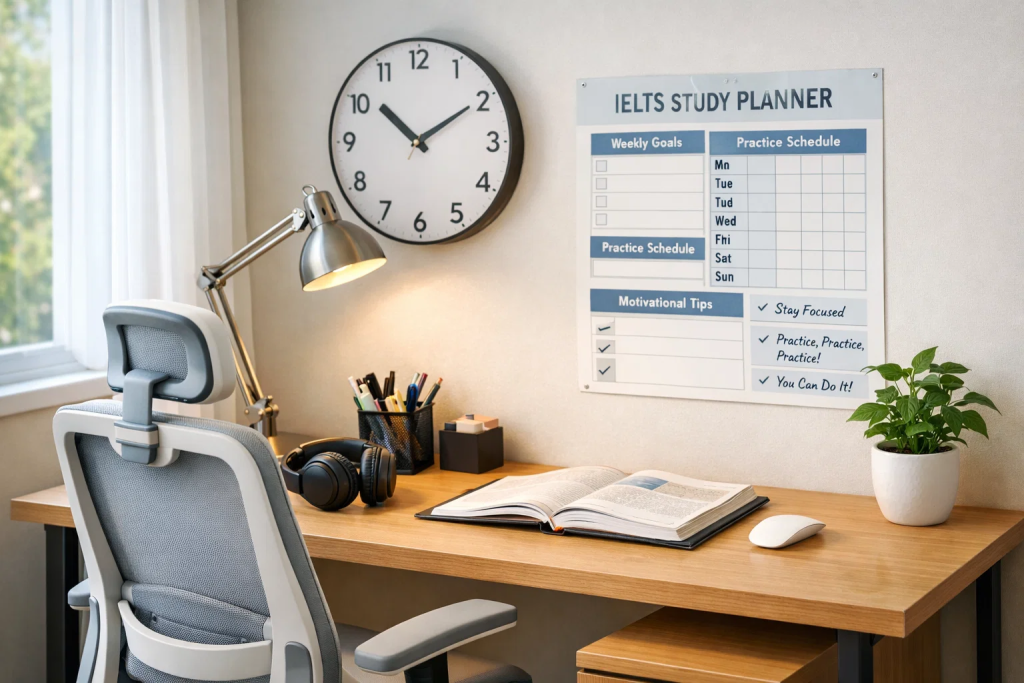
Your physical study space significantly impacts learning effectiveness when you prepare for IELTS at home. Designate a specific area exclusively for IELTS preparation—whether a dedicated room, corner desk, or table section—that signals your brain it’s time for focused study. This psychological association between space and learning enhances concentration and productivity.
Essential elements for your IELTS study space include:
Create a distraction-free zone by communicating your study schedule with family members. Request they minimize interruptions during designated preparation times. Turn off social media notifications, use website blockers if needed, and establish clear boundaries that protect your learning time.
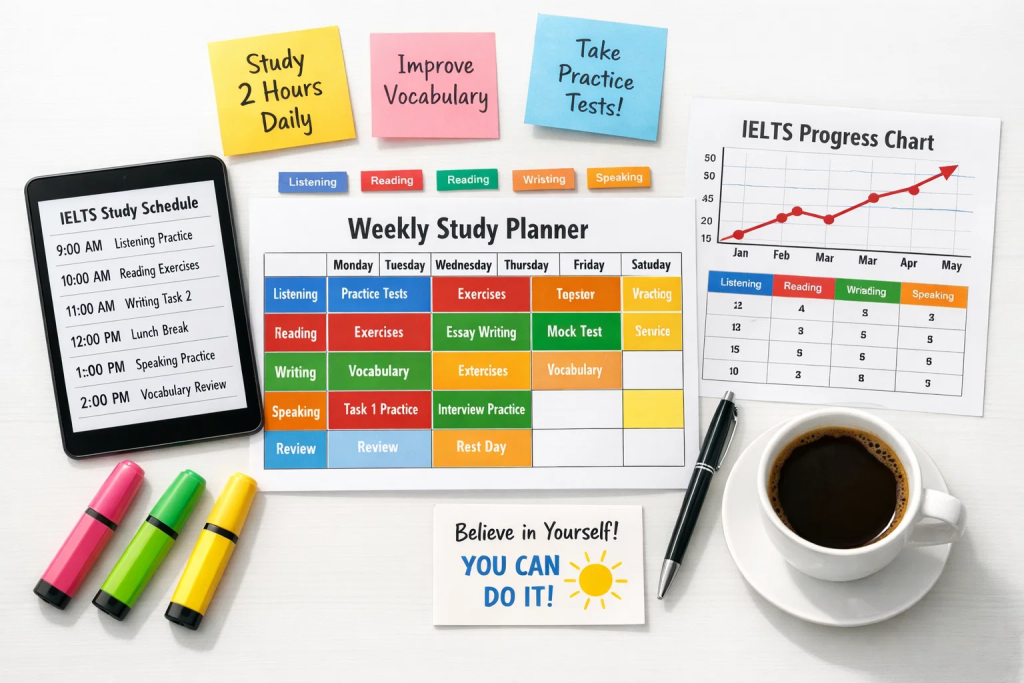
Strategic planning transforms random study efforts into systematic progress when you prepare for IELTS at home. Your personalized study plan should reflect your current English level, target band score, available preparation time, and individual strengths and weaknesses across the four IELTS sections.
Start with diagnostic assessment. Take a complete IELTS practice test under timed conditions to establish your baseline scores. Analyze results to identify which sections need most attention. Perhaps your Listening and Reading scores exceed requirements, but Writing and Speaking need substantial improvement. This analysis determines how you allocate study time across different components.
Realistic timeline planning matters tremendously. Students with intermediate English proficiency typically need 2-3 months of dedicated daily preparation to achieve 6.5-7.0 band scores. Advanced learners might require 4-6 weeks, while beginners should plan 4-6 months. Be honest about your starting point—underestimating preparation time leads to rushed, ineffective study and disappointing test results.
Daily study schedule structure:
Include buffer time for unexpected disruptions. Life happens—family obligations, health issues, or work commitments may interrupt plans. Build flexibility into your schedule so occasional missed sessions don’t derail overall progress.
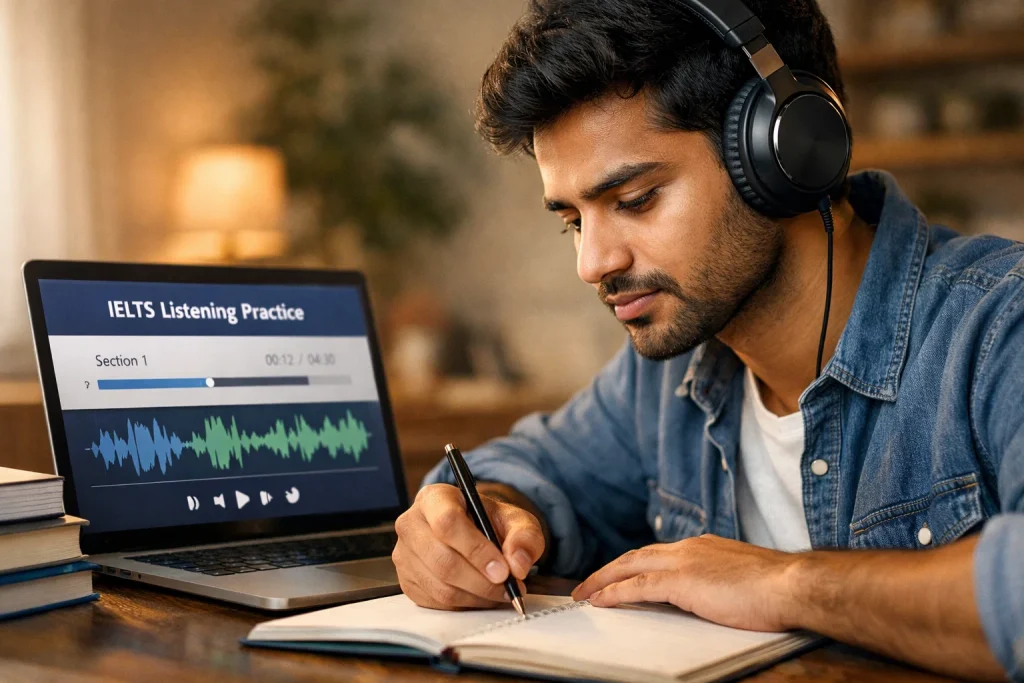
The Listening section challenges many test-takers because it happens in real-time with no opportunity to replay recordings during the actual test. However, when you prepare for IELTS at home, you can develop powerful listening strategies through systematic practice and diverse audio exposure.
Understanding Listening format: Four sections with increasing difficulty feature different contexts—Section 1 (conversation in social context), Section 2 (monologue in social context), Section 3 (conversation in educational/training context), Section 4 (monologue on academic subject). You hear each recording once and must answer 40 questions across various types: multiple choice, matching, plan/map/diagram labeling, form/note/table/flow-chart/summary completion, and sentence completion.
Home practice strategies for Listening excellence:
Accent familiarization forms the foundation. IELTS uses speakers with British, Australian, New Zealand, North American, and other English accents. Regular exposure to diverse accents prevents confusion during the actual test. Watch BBC News, Australian Broadcasting Corporation programs, Canadian podcasts, and American documentaries. This varied exposure trains your ear to understand different pronunciation patterns, intonation, and speaking speeds.
Active listening exercises develop the skill of listening for specific information while understanding overall context. Start with TED Talks, news broadcasts, or academic lectures. Listen once without notes, then replay while taking structured notes using abbreviations and symbols. Practice predicting what information might come next based on context clues. This anticipation skill helps you prepare for upcoming answers during the actual test.
Dictation practice sharpens your ability to catch exact words and spellings. Select audio passages at natural speaking speed, listen to sentences, pause, and write exactly what you heard. Compare your written version with transcripts to identify consistent errors. Common challenges include missing articles (a, an, the), plurals, or verb tenses—all areas where IELTS tests precision.
Question prediction technique: Before each recording plays, use the 30-second preview time strategically. Read questions carefully, underline keywords, anticipate answer types (number, name, date, etc.), and prepare your mind for the information you’re listening for. This proactive approach dramatically improves answer accuracy.
Common Listening pitfalls to avoid: Don’t write answers while listening to the first time—focus entirely on understanding. Use the second listening (during practice) to verify and complete answers. Never leave blanks; educated guesses based on context often earn points. Watch for distractors—speakers often mention multiple options before stating the correct answer. Train yourself to distinguish between mentioned information and actual answers.
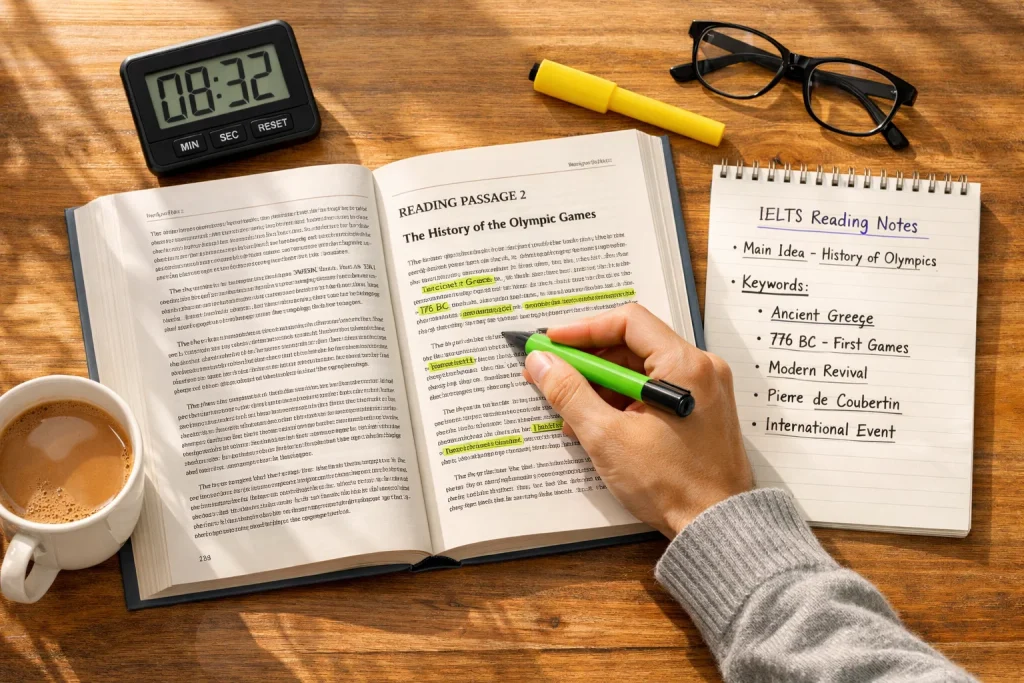
Reading comprehension determines academic success in English-medium universities, making this section crucial for students planning to study abroad. The IELTS Academic Reading section presents three lengthy passages with increasing difficulty, totaling approximately 2,750 words, which you must read and answer 40 questions within 60 minutes.
Passage types and question formats: Texts come from books, journals, magazines, and newspapers, covering topics from descriptive and factual to discursive and analytical subjects. Question types include multiple choice, identifying information (True/False/Not Given), identifying writer’s views/claims (Yes/No/Not Given), matching information/headings/features/sentence endings, sentence/summary/note/table/flow-chart completion, diagram label completion, and short-answer questions.
Time management strategies when you prepare for IELTS at home:
Successful Reading performance depends on effective time allocation. Spend approximately 20 minutes per passage, including reading time and answering questions. Practice this pacing religiously during home preparation so it becomes automatic on test day. Many students make the critical error of spending 30+ minutes on the first passage, leaving insufficient time for remaining sections.
Skimming and scanning techniques accelerate comprehension without sacrificing accuracy. Skimming involves quickly reading to grasp main ideas, topic sentences, and overall structure within 2-3 minutes. Focus on introduction, conclusion, and first sentences of body paragraphs. Scanning means rapidly searching for specific information like names, dates, numbers, or keywords from questions. Practice both skills separately before combining them in timed tests.
The question-first strategy revolutionizes reading efficiency. Instead of reading the entire passage first, read questions to understand what information you’re searching for, then locate relevant passage sections. This targeted approach saves time and improves accuracy. However, questions testing overall understanding (like headings or main ideas) require reading the complete passage or paragraph.
Vocabulary building for Reading success: IELTS Academic Reading contains sophisticated vocabulary from various academic disciplines. Create systematic vocabulary lists from practice passages, organize words by topic (environment, technology, education, health, etc.), learn contextual usage rather than isolated definitions, and practice using new words in sentences. Understanding word families (conserve, conservation, conservative, conservationist) expands vocabulary efficiency.
Handling True/False/Not Given questions: These questions challenge many test-takers. “True” means the statement agrees with information in the passage, “False” means it contradicts passage information, and “Not Given” means the passage doesn’t provide information to confirm or deny the statement. Never use your general knowledge—base answers solely on passage content. Practice distinguishing between “False” (contradicts passage) and “Not Given” (no relevant information) through extensive question practice.
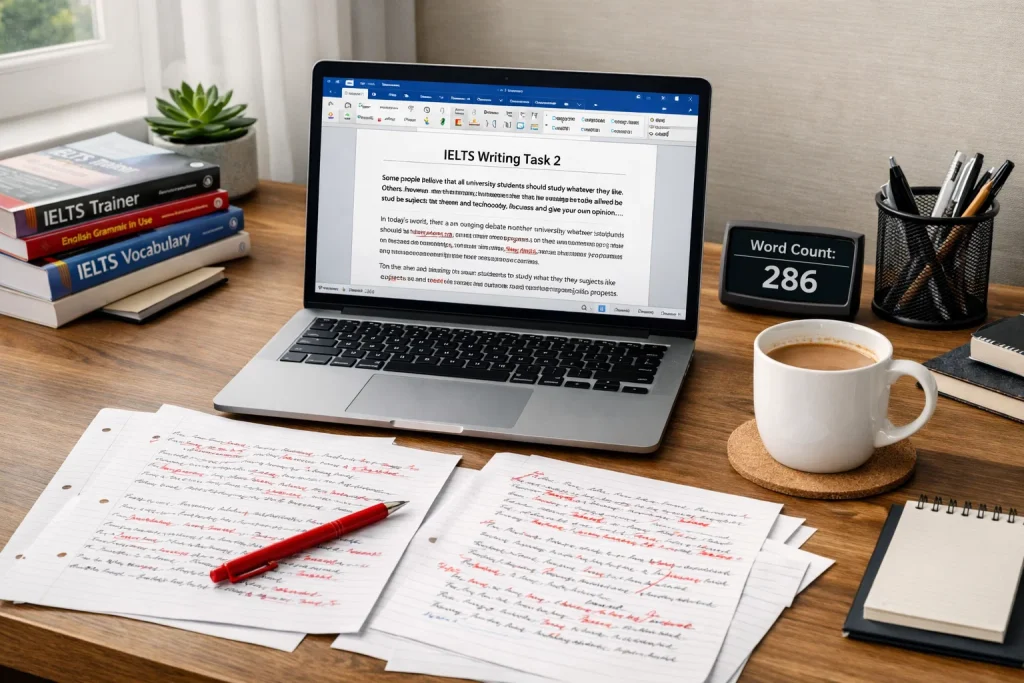
Writing often proves most challenging for students who prepare for IELTS at home because it requires both language proficiency and strategic thinking. The Writing section contains two compulsory tasks you must complete in 60 minutes, with Task 2 carrying twice the weight of Task 1 in overall Writing score calculation.
Task 1 Academic requires describing, summarizing, or explaining visual information (graphs, tables, charts, diagrams, maps, processes) in minimum 150 words within 20 minutes. You must identify main trends, make comparisons, and present data objectively without opinions. Common graph types include line graphs showing trends over time, bar charts comparing categories, pie charts displaying proportions, tables presenting detailed data, process diagrams illustrating how something works, and maps showing changes over time.
Task 2 presents an argument, problem, or viewpoint requiring a written response of minimum 250 words in 40 minutes. You must develop position, support arguments with relevant examples, organize ideas logically, and demonstrate language range and accuracy. Question types include opinion essays (agree/disagree, advantages/disadvantages), discussion essays (discuss both views), problem-solution essays, and two-part questions.
Writing improvement strategies for home learners:
Understanding assessment criteria guides effective preparation. Both tasks evaluate Task Achievement/Response (addressing all parts of the question, presenting clear position, supporting ideas with examples), Coherence and Cohesion (logical organization, effective paragraphing, appropriate linking words), Lexical Resource (vocabulary range, precision, collocations, spelling), and Grammatical Range and Accuracy (sentence variety, complex structures, error-free writing).
Model answer analysis accelerates learning. Study high-scoring sample responses to understand structure, vocabulary usage, and argument development. Don’t memorize essays—examiners recognize and penalize memorized content. Instead, analyze how model answers introduce topics, develop arguments, use examples, employ cohesive devices, conclude effectively, and maintain academic tone. Extract techniques you can adapt to various topics.
Regular writing practice remains non-negotiable. Write minimum one complete task daily, alternating between Task 1 and Task 2. Use official IELTS practice materials or reputable preparation books. Time yourself strictly—20 minutes for Task 1, 40 minutes for Task 2. This timed practice develops speed and teaches you to plan, write, and review within constraints.
Self-assessment and feedback: Since professional feedback might not be available at home, develop self-evaluation skills. After completing essays, wait several hours or until the next day before reviewing with fresh perspective. Check against assessment criteria: Did you address all question parts? Is your position clear? Are ideas well-organized with appropriate paragraphs? Did you use varied vocabulary and grammar? Count words to ensure minimum requirements. Identify recurring errors in grammar, spelling, or coherence to focus improvement efforts.
Grammar and sentence structure refinement: IELTS Writing rewards grammatical range and accuracy. Practice complex sentences using subordinating conjunctions (although, because, while, whereas), relative clauses (which, who, that, where), and conditional structures (if…then). However, avoid overly complex sentences that become confusing. Clarity always trumps complexity. Mix simple, compound, and complex sentences for natural flow.
Vocabulary enhancement for Writing: Move beyond basic words to demonstrate lexical resource. Instead of “good,” use beneficial, advantageous, favorable, or valuable depending on context. Learn topic-specific vocabulary for common IELTS subjects: education, environment, technology, health, society, government. Use academic word lists and collocation dictionaries to discover natural word combinations. Practice paraphrasing to avoid repetition and demonstrate vocabulary range.

The Speaking section often creates anxiety for students who prepare for IELTS at home because it involves face-to-face conversation with an examiner. However, systematic preparation and regular practice significantly boost confidence and performance. The 11-14 minute interview consists of three parts testing different speaking skills.
Part 1 (4-5 minutes) covers familiar topics like home, family, work, studies, hobbies, and interests through short questions and brief answers. Part 2 (3-4 minutes) presents a task card with a topic requiring a 1-2 minute individual presentation after 1 minute of preparation. You must speak continuously on the given topic, addressing all points on the task card. Part 3 (4-5 minutes) involves discussion of abstract ideas and issues related to Part 2 topic through two-way conversation with the examiner.
Home practice techniques for Speaking excellence:
Recording and reviewing responses provides invaluable self-feedback when formal teachers aren’t available. Use smartphone recording apps to capture your practice sessions. After recording, listen critically to identify areas needing improvement: Did you speak clearly and at appropriate speed? Were answers well-organized with relevant examples? Did you use varied vocabulary and grammar? Were there long pauses or frequent self-corrections? Note pronunciation issues, grammatical errors, and areas where vocabulary limited expression.
Topic familiarization prepares you for the wide range of potential Speaking questions. Create cards with common IELTS topics (travel, technology, education, environment, health, sports, music, food, etc.) and practice speaking spontaneously for 2 minutes on each topic. This preparation builds confidence in discussing unfamiliar subjects, develops the skill of thinking in English rather than translating from your native language, and creates a mental database of relevant vocabulary and ideas.
Developing fluency and coherence: Fluency means speaking smoothly without excessive hesitation or repetition. Practice speaking on various topics for increasing durations—start with 1 minute, progress to 2 minutes, then extend to 3-4 minutes. Use discourse markers (firstly, secondly, moreover, however, for instance) to connect ideas logically. Don’t memorize entire responses—examiners recognize and penalize this. Instead, prepare frameworks and flexible expressions you can adapt to different questions.
Pronunciation improvement strategies: Clear pronunciation ensures the examiner understands you easily. Practice individual sounds that don’t exist in your native language or that you find challenging. Record yourself reading aloud, then compare with native speakers. Focus on word stress (which syllable receives emphasis), sentence stress (which words carry meaning weight), and intonation patterns (rising for questions, falling for statements). These elements contribute significantly to pronunciation scores.
Building lexical resource for Speaking: While sophisticated vocabulary impresses, appropriateness matters more than complexity. Learn phrasal verbs and idiomatic expressions common in natural English conversation. For example, instead of “I need to solve this problem,” say “I need to figure this out” or “I need to work through this issue.” Practice topic-specific vocabulary so you can discuss technology, environment, education, or culture with relevant terminology.
Managing Speaking anxiety: Nervousness affects performance, but preparation reduces anxiety. Simulate test conditions at home by sitting across from a mirror, family member, or study partner. Practice making eye contact and maintaining good posture. Remember that examiners expect natural conversation, not perfect English. They assess communication effectiveness, not native-level fluency. Small mistakes don’t significantly impact scores if you communicate ideas clearly.
Part 2 preparation strategy: Use the 1-minute preparation time efficiently. Read the task card carefully, identify all points you must address, jot down brief keywords (not sentences) to structure your response, and plan opening and closing statements. During the 2-minute speaking time, address all bullet points on the card, use personal examples to illustrate points, maintain continuous speaking without long pauses, and conclude naturally even if you haven’t filled the entire 2 minutes.
Access to quality materials determines preparation effectiveness when you prepare for IELTS at home. While numerous resources exist, focusing on authentic, exam-relevant materials produces better results than scattered, low-quality sources.
Official IELTS materials provide authentic practice:
The official IELTS websites (British Council, IDP, Cambridge Assessment English) offer free sample tests, practice materials, and preparation resources. These materials use actual test formats and difficulty levels, ensuring your practice reflects real exam conditions. “IELTS Advantage” and official IELTS preparation apps provide mobile-friendly practice for on-the-go learning.
Recommended books for comprehensive preparation:
“The Official Cambridge Guide to IELTS” contains authentic practice tests and detailed strategies. “IELTS Practice Tests Plus” series offers extensive practice with answer explanations. “Barron’s IELTS Superpack” provides comprehensive coverage across all sections. “Collins IELTS Grammar and Vocabulary” strengthens foundational language skills essential for high band scores.
Online platforms and YouTube channels:
Several YouTube channels offer free, high-quality IELTS preparation content. “IELTS Liz” provides clear explanations, practice materials, and tips across all sections. “E2 IELTS” offers structured lessons and practice sessions. “IELTS Advantage” presents strategies and common mistake analyses. These channels supplement book learning with visual explanations and authentic examples.
Vocabulary and grammar resources:
“Academic Word List” contains 570 word families frequently appearing in academic texts—essential for Reading and Writing. “IELTS Vocabulary Booster” applications offer systematic word learning with contextual examples. Grammar resource websites like “Perfect English Grammar” and “British Council LearnEnglish” provide free lessons on structures essential for Writing and Speaking.
Listening practice materials:
BBC Learning English offers free lessons, podcasts, and news content with transcripts. TED Talks provide academic content similar to IELTS Listening Section 4. National Public Radio (NPR) and ABC News podcasts expose you to North American accents. British Council IELTS podcasts specifically target test preparation with exam-format practice.
Reading practice sources:
“The Guardian,” “The Economist,” “Scientific American,” and “National Geographic” publish articles similar in style and complexity to IELTS Reading passages. Regular reading of these publications builds vocabulary, improves comprehension speed, and familiarizes you with academic writing styles. Focus on reading 750-1000 word articles daily to build stamina for the 60-minute Reading section.
Speaking practice solutions:
Language exchange platforms connect you with English speakers for conversation practice. Apps like “HelloTalk,” “Tandem,” or “ConversationExchange” facilitate free speaking practice with native or fluent speakers. Online IELTS speaking practice platforms offer AI-based feedback on pronunciation, fluency, and grammar. While not replacing human interaction, these tools provide valuable supplementary practice.
If you’re planning to study abroad, professional guidance can complement your self-study efforts. Admission counseling services often provide standardized test preparation support including IELTS resources, practice materials, and strategic guidance tailored to your target universities’ requirements.
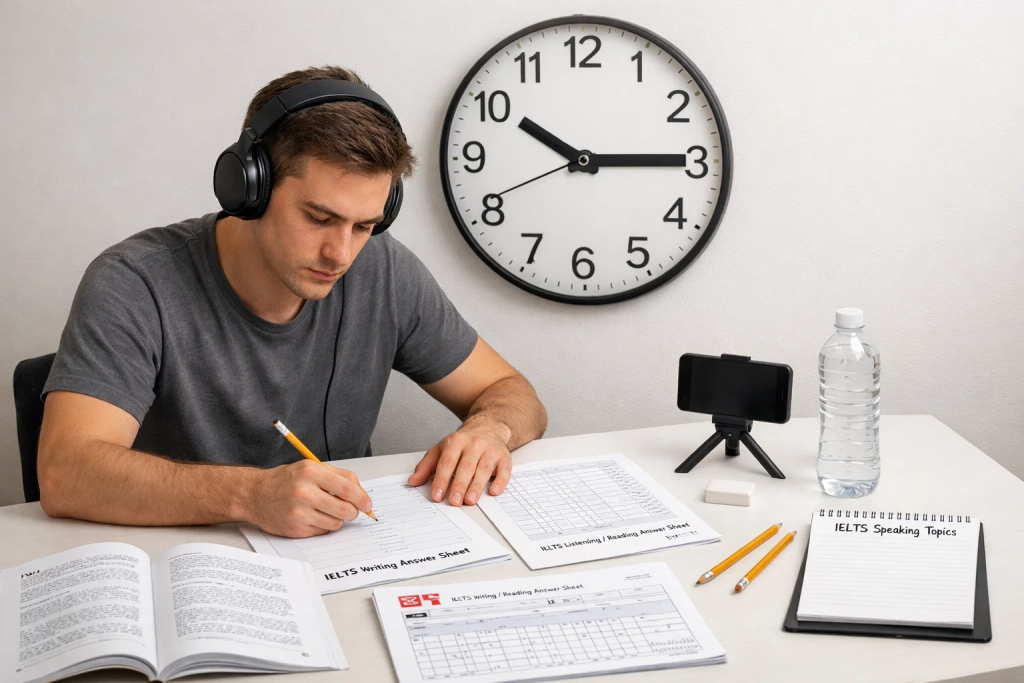
Regular practice tests measure progress and familiarize you with exam conditions when you prepare for IELTS at home. However, many students misuse practice tests, treating them as learning tools rather than assessment instruments. Understanding the strategic role of mock examinations maximizes their benefit.
Practice test timing strategy:
Take your first complete practice test at the beginning of preparation to establish baseline scores and identify weaknesses. Schedule subsequent full-length tests every 2-3 weeks to monitor improvement and adjust study focus. Increase test frequency to weekly during the final month before your actual exam. This progressive approach prevents practice material exhaustion while providing regular performance feedback.
Simulating test conditions:
Effective practice requires authentic exam simulation. Complete all four sections in one sitting under strict time limits: Listening (30 minutes), Reading (60 minutes), Writing (60 minutes), Speaking (11-14 minutes). Use official answer sheets to practice transferring answers correctly. Eliminate all distractions—turn off phones, close unnecessary browser tabs, inform family members not to disturb you. This realistic practice builds test-taking stamina and reduces anxiety on actual exam day.
Score analysis and improvement planning:
After each practice test, analyze results systematically. Calculate scores for each section and overall band score. Identify patterns in mistakes: Do you consistently struggle with True/False/Not Given questions in Reading? Are Task 1 graph descriptions weak in Writing? Does Part 3 Speaking lack depth? Use this analysis to adjust your study plan, allocating more time to problematic areas.
Answer review technique:
Don’t just note which answers were wrong—understand why. For Listening and Reading, review incorrect answers to identify whether you misunderstood the question, missed key information, or made careless errors. For Writing, compare your responses against model answers and assessment criteria. For Speaking, listen to recordings to identify fluency breaks, vocabulary limitations, or pronunciation issues.
Using practice test results strategically:
Track scores across multiple tests to visualize progress trends. Create a simple spreadsheet recording test dates and section scores. Upward trends indicate effective preparation, while stagnant scores signal the need for strategy changes. If scores plateau despite regular practice, consider adjusting study methods, seeking external feedback on Writing and Speaking, or addressing underlying grammar/vocabulary gaps.
Avoiding practice test pitfalls:
Never check answers during a practice test—complete the entire exam before reviewing. This discipline mirrors actual test conditions where you can’t verify answers mid-section. Don’t retake the exact same practice test within a few weeks—familiar content inflates scores artificially, providing false confidence. Maintain a library of fresh practice materials by using tests strategically and spreading them throughout your preparation period.
Learning from common errors accelerates progress when you prepare for IELTS at home. Many students repeat preventable mistakes that limit their potential band scores. Understanding these pitfalls helps you navigate preparation more effectively.
Neglecting time management practice: Students often practice sections without time pressure, then struggle during the actual exam. Always practice under timed conditions, even when learning new strategies. Speed and accuracy must develop together—accuracy without speed fails in IELTS’s strictly timed format.
Focusing exclusively on weak areas: While addressing weaknesses makes sense, completely neglecting strong sections can cause score deterioration. Maintain all skills throughout preparation with balanced practice across Listening, Reading, Writing, and Speaking, even if you allocate more time to weaker areas.
Memorizing templates and model answers: Examiners quickly recognize memorized content and penalize it significantly. IELTS assesses your English ability, not memorization skills. Instead of memorizing entire essays or speaking responses, learn flexible frameworks and expressions you can adapt to various topics. Understand underlying principles rather than specific answers.
Ignoring instruction words in Writing: Task 2 questions use specific instruction words—discuss, agree/disagree, evaluate, analyze—requiring distinct approaches. “Discuss both views” demands balanced coverage of different perspectives, while “Do you agree or disagree?” expects a clear personal position. Misinterpreting instructions causes Task Achievement/Response score reductions regardless of language quality.
Overlooking word count requirements: Writing responses below the minimum word count (150 for Task 1, 250 for Task 2) automatically reduces Task Achievement scores. Conversely, excessive wordiness beyond 200-220 words for Task 1 or 320-350 for Task 2 wastes valuable time without improving scores. Practice meeting word count requirements naturally without constant counting.
Reading questions carelessly: Many students lose points not from English deficiency but from misreading questions. Does the Reading question ask for “more than three words” or “no more than three words”? Is the Listening instruction “write a number and a word” or “write a number or a word”? These details significantly impact answer acceptability. Train yourself to read instructions meticulously.
Neglecting Speaking practice due to embarrassment: Many students who prepare for IELTS at home avoid Speaking practice because recording themselves feels awkward or they lack conversation partners. This avoidance severely limits Speaking score improvement. Overcome initial discomfort—regular recording becomes natural after a few sessions, and the self-feedback proves invaluable.
Waiting for “perfect English” before taking IELTS: English proficiency develops gradually through exposure and practice, not sudden breakthroughs. If you’ve prepared systematically for 2-3 months and consistently achieve target scores in practice tests, you’re ready for the actual exam. Excessive delay seeking “perfect” English wastes time and postpones your study abroad plans unnecessarily.
Relying solely on self-study for Writing assessment: While most IELTS preparation happens effectively at home, Writing benefits tremendously from external feedback. Consider occasionally using online IELTS Writing correction services, joining online study groups for peer review, or consulting education abroad counselors who can provide expert Writing evaluation as part of comprehensive admission guidance.
Yes, you can absolutely prepare for IELTS at home and achieve excellent band scores through self-study. With the right resources, structured study plan, consistent daily practice for 2-3 months, and access to official IELTS materials, thousands of students successfully reach their target scores without attending coaching centers. The key is maintaining discipline, using quality practice materials, and regularly assessing your progress through mock tests.
The preparation timeline varies based on your current English proficiency level and target band score. Students with intermediate English typically need 2-3 months of dedicated daily practice (2-3 hours) to achieve 6.5-7.0 band scores, while advanced learners may require 4-6 weeks, and beginners should plan for 4-6 months. Consistent daily practice produces better results than sporadic intensive study sessions.
Official IELTS websites (British Council, IDP, Cambridge Assessment) offer free sample tests and practice materials that reflect actual exam formats. YouTube channels like IELTS Liz, E2 IELTS, and IELTS Advantage provide comprehensive free lessons, while BBC Learning English, TED Talks, and news websites like The Guardian offer excellent listening and reading practice. These authentic resources combined with official IELTS practice books provide everything needed for thorough home preparation.
Record yourself using smartphone apps while answering IELTS speaking questions, then review recordings to identify areas for improvement in fluency, pronunciation, and grammar. Use language exchange apps like HelloTalk or Tandem to connect with English speakers for free conversation practice, practice speaking in front of a mirror to build confidence, and join online IELTS study groups for peer practice sessions. Regular recording and self-assessment significantly improve speaking performance even without formal partners.
IELTS score requirements vary by country, university, and program, but most institutions require overall band scores between 6.0-7.5 for admission. Canadian study permits through Student Direct Stream require IELTS 6.0 overall with no band below 6.0, while UK nursing programs typically need 6.5-7.0 overall with no component below 6.5, and top universities in the US, UK, and Australia often require 7.0-7.5 for competitive programs. Always verify specific requirements with your target institutions as they can vary significantly.
Take your first complete practice test at the beginning to establish baseline scores, then schedule full-length tests every 2-3 weeks to monitor progress throughout your preparation period. Increase test frequency to weekly during the final month before your actual exam, ensuring you complete at least 6-8 full practice tests during a 2-3 month preparation period. Quality matters more than quantity—thoroughly analyze each test to identify patterns in mistakes and adjust your study strategy accordingly.
Yes, achieving 7+ band scores through home preparation is absolutely possible with strategic study, quality resources, and consistent practice over 2-4 months. Many self-study students score 7.5-8.5 by focusing on understanding assessment criteria, practicing all four sections regularly, analyzing mistakes thoroughly, and developing strong time management skills. Success depends on your current English level, dedication to daily practice, and using authentic IELTS materials that reflect actual test difficulty and format.
Preparing for IELTS at home requires discipline, strategy, and consistent effort, but thousands of students achieve outstanding band scores through self-study each year. The comprehensive approach outlined in this guide—understanding test format, creating effective study environments, developing personalized plans, mastering section-specific strategies, using quality resources, taking regular practice tests, and avoiding common mistakes—provides everything needed for IELTS success without expensive coaching.
Your journey to achieving the required IELTS scores opens doors to world-class universities, international career opportunities, and life-changing educational experiences. Whether you’re planning to study in the Netherlands, pursue nursing in the UK, or apply for Canadian study permits, strong IELTS performance serves as your gateway to these opportunities.
Begin your preparation today with clear goals, systematic planning, and unwavering commitment. Track your progress through regular practice tests, adjust strategies based on results, and maintain confidence in your ability to succeed. Remember that consistent daily practice for 2-3 months produces better results than sporadic, intensive study. The effort you invest in preparing for IELTS at home will reward you with not just target band scores, but genuine English proficiency that serves you throughout your academic and professional journey.
Take the first step now—assess your current level, set your target score, create your study schedule, and commit to the process. Your study abroad dreams await, and IELTS is simply the first milestone on that exciting path. For additional support with university applications, visa processes, and study abroad planning, explore comprehensive education abroad counseling services that complement your IELTS preparation efforts.